A Brief History
The Vaughan Family is thought to have settled in Southampton County about 1750. Thomas Vaughan Jr. built his Federal-style house on 210 acres in about 1795. He then married Rebecca Foster. In the 1810 census, Thomas Vaughan is listed as the head of the household and owning six enslaved persons. Thomas and Rebecca had two daughters, Mary and Martha, as well as two sons, George and Arthur. By the time of his death in 1816, Thomas enslaved 12 people.
Rebecca Vaughan was still a widow in 1831 and was highly respected throughout the county. Her two sons lived with her; however, her daughters married and lived nearby. In 1824, Martha married James T. Parker; Mary married Captain John Barrow in 1828. All would play a major role in the 1831 Southampton Insurrection.
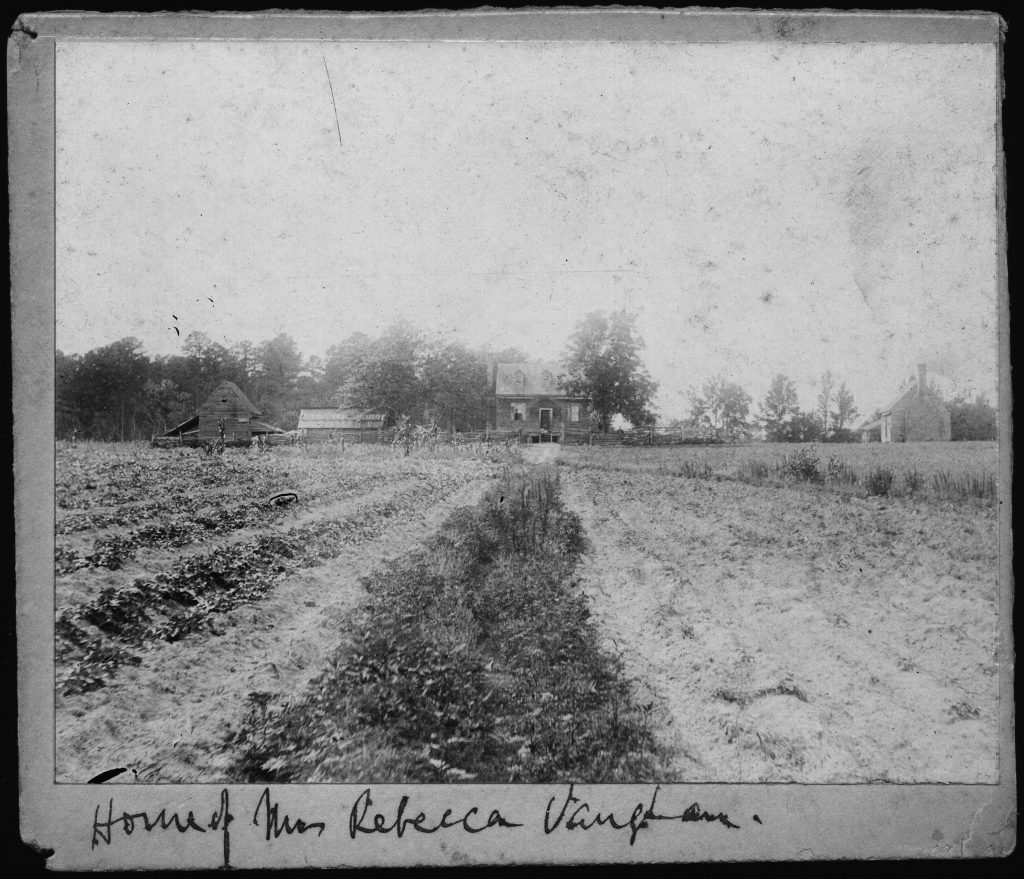
Captain John Barrow had defended his home when Nat Turner’s followers arrived to enable his wife to escape. Barrow was killed after a brief battle with the insurgents. George Vaughan was en route to the Barrow House to pick up his sister and meet some fox hunters when he was killed by members of Nat Turner’s army. As Turner’s men continued down Barrow Road, they visited several other houses and took the lives of many enslavers, including Edwin Drewry and the Williams family, before they arrived at the entrance to the lane that led to the Rebecca Vaughan House.
It was about noon on 22 August 1831 when around 60 rebels rode toward the house in a cloud of dust. Arthur was with his overseer between the stillhouse and the kitchen. Rebecca was on the front porch preparing for the arrival of the fox hunters. Her niece, Miss Anne Eliza (Elizabeth) Vaughan, the daughter of John T. Vaughan, was dressing upstairs. Anne Eliza was known as a “lovely young girl of eighteen, the beauty of the county.”
Nothing seemed abnormal as the dust billowed skyward, caused by the pounding of horses’ hooves on the dirt lane. Quickly, the insurgents rushed into the yard and killed Arthur and the overseer. The death throes, yells, and screams prompted Anne Eliza to rush downstairs to see what all the noise was about. As she reached the front door, she was shot and thrown into the yard dead. Meanwhile, Rebecca pleaded with Nat Turner’s men to allow her time to make her peace with God. Sadly, she prayed too long, prompting several insurrectionists to rush upstairs and kill her on her knees.
Nat Turner, sitting on his horse, watched the scene silently. He had not killed anyone since he and his men attacked the Catherine Whitehead House. As he stared at the dead strewn about in the yard in the sweltering August sun, Turner must have been seeking divine advice before plotting his next moves. They had left a path of destruction and death behind them, but he knew that news of his insurrection was now spreading rapidly throughout the county. He had more than 60 men armed with guns, swords, axes, and other implements of death. He recognized that his command needed to reach Jerusalem soon to spread more terror and fear. Turner’s soldiers also needed more arms and ammunition. Once in Jerusalem, it is unclear what Turner’s next move was to be. As his men waited for orders, they went to the kitchen and demanded brandy from the cook. She obliged their wishes; however, the raiders spat it out, declaring it “vile stuff!” Nat Turner, realizing that the heavy drinking was weakening the men’s resolve, commanded them to march, “On to Jerusalem!”